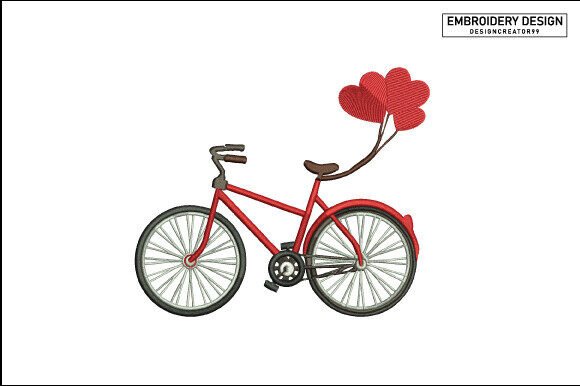
Valentine Love Embroidery Design Review
As an embroidery designer who has spent years digitizing files for small businesses, I approach every new machine embroidery design with a critical eye. It is not enough for a file to look pretty on a screen; it must perform under the needle, withstand washing, and elevate the brand it represents. Recently, I reviewed the Valentine Love Embroidery Design, a charming piece featuring a vintage bicycle adorned with love accents. While marketed primarily for romantic gifts and festive apparel, I wanted to evaluate its potential for serious commercial use. Can this whimsical motif work for branded merchandise, staff uniforms, or boutique product lines? Here is my professional assessment.
First Impressions: Visual Personality and Brand Fit
The first thing that strikes you about the Valentine Love Embroidery Design is its narrative quality. The vintage bicycle motif suggests nostalgia, warmth, and a slow-paced appreciation for life. For a business, this translates to a brand personality that is friendly, approachable, and artisanal. It does not scream "corporate" or "industrial." Instead, it feels handmade, rustic, and decorative.
This visual language is crucial for specific industries. If you run a local bakery, a florist shop, a pet grooming studio, or a boutique coffee house, this design aligns perfectly with a customer experience that values care and tradition. However, for a tech startup or a high-end luxury fashion label, the playful nature of the bicycle might feel too casual. Understanding where your brand sits on the spectrum from playful to premium is the first step in deciding if this digital embroidery file belongs in your asset library.
Commercial Applications Beyond Valentine S Day
While the product category is listed as Valentine S Day, limiting this design to February sales would be a missed opportunity. In the world of commercial embroidery, thematic designs can be repurposed creatively. Here is how I envision this design working for small business merch and branded items:
- Apron Embroidery: For bakeries or cafes, placing this design on the chest pocket of a canvas apron adds a touch of whimsy that customers love. It breaks the monotony of plain uniforms and serves as a conversation starter.
- Tote Bag Design: The horizontal spread of a bicycle often works well on tote bags. This makes for an excellent reusable shopping bag for bookstores or gift shops, reinforcing eco-friendly values alongside brand recognition.
- Embroidered Patch: Creating a custom patch allows for versatility. You can sew these onto denim jackets, backpacks, or even pet bandanas. Patches also allow you to control the backing and application method, which is vital for textured fabrics.
- Cap Embroidery: A simplified version of this design could work on the side panel of a dad hat. However, caution is needed here due to the curvature of the cap and the detailed nature of bicycle spokes.
The key to successful custom apparel is context. By using this design on everyday items like tote bags or aprons, you extend the life of the motif beyond the holiday season, turning a seasonal asset into a year-round brand identifier.
Technical Considerations for Production
From a technical standpoint, any design featuring a vehicle, especially one with "accents," requires careful scrutiny before hitting the production floor. The vintage bicycle likely involves fine lines for the frame and wheels. When scaling this down for an embroidered patch or a left-chest logo, those fine lines can become problematic.
Stitch density is a major factor. If the original digitizer packed too many stitches into the wheel spokes or the heart accents, the thread may break, or the fabric may pucker. Conversely, if the density is too low, the design may look sparse and unprofessional. I always recommend running a test stitch-out on a similar fabric to your final product. Do not assume the default settings will work for every material.
Another critical element is thread colors. The description mentions "love accents," which implies reds or pinks. Ensure there is sufficient contrast between the bicycle frame and the background fabric. If you are embroidering on dark uniforms, you may need to add an underlay or choose lighter thread shades to maintain visibility. Always check the hoop size requirements. If the design is large, ensure your machine can accommodate it without re-hooping, which can lead to alignment issues.
Navigating Fabric Texture and Stabilizer Choice
The success of the Valentine Love Embroidery Design heavily depends on the substrate. On smooth cotton or poly-cotton blends, the details should render clearly. However, on textured fabrics like terry cloth towels or heavy canvas, small details may get lost. In such cases, consider simplifying the design or increasing the scale.
Proper stabilization is non-negotiable. For stretchy fabrics like t-shirts, a cut-away stabilizer is essential to prevent distortion. For woven materials like tote bags or aprons, a tear-away might suffice, but a cut-away provides a more professional, durable finish. Remember, a finished product that puckers or shifts after washing reflects poorly on your brand, not just the design file.
Enhancing Brand Identity and Customer Trust
Why invest in a unique design like this? Because consistency builds trust. When customers see the same high-quality design assets across your website, packaging, and staff uniforms, it reinforces your brand identity. A well-executed embroidery project signals attention to detail. It tells the customer that you care about quality, which justifies higher price points for your handmade product or service.
Furthermore, offering branded merchandise with unique embroidery differentiates you from competitors who rely on generic print-on-demand services. Embroidery has a tactile, premium feel that prints cannot replicate. It adds perceived value to the item, making it more likely to be kept and used, thereby extending your brand’s visibility.
Practical Designer Notes for Implementation
Before you purchase and produce, follow these steps to ensure success:
- Test in Black and White: Convert the preview to grayscale to check for contrast issues. If the design disappears in black and white, it may lack definition on certain fabrics.
- Check Small Sizes: Scale the design down to 2 inches wide in your software. If the details merge or become indistinguishable, it is not suitable for small patches or chest logos without modification.
- Review Licensing: Confirm the commercial licensing terms. Ensure you have the right to use the digital embroidery file for physical goods you intend to sell.
- Create a Printable Mockup: Use a printable mockup to visualize the design on various products before stitching. This helps in client approvals and marketing materials.
- Verify File Formats: Ensure the download includes the format compatible with your machine (e.g., PES, DST, JEF). The product description does not specify formats, so check this before buying.
In conclusion, the Valentine Love Embroidery Design is a versatile asset for businesses that value charm and craftsmanship. While it shines in romantic contexts, its true potential lies in its ability to add a personal, handmade touch to everyday branded items. With careful attention to technical details like stabilizer choice and stitch density, this design can become a staple in your small business merch lineup, enhancing both aesthetic appeal and brand loyalty.